
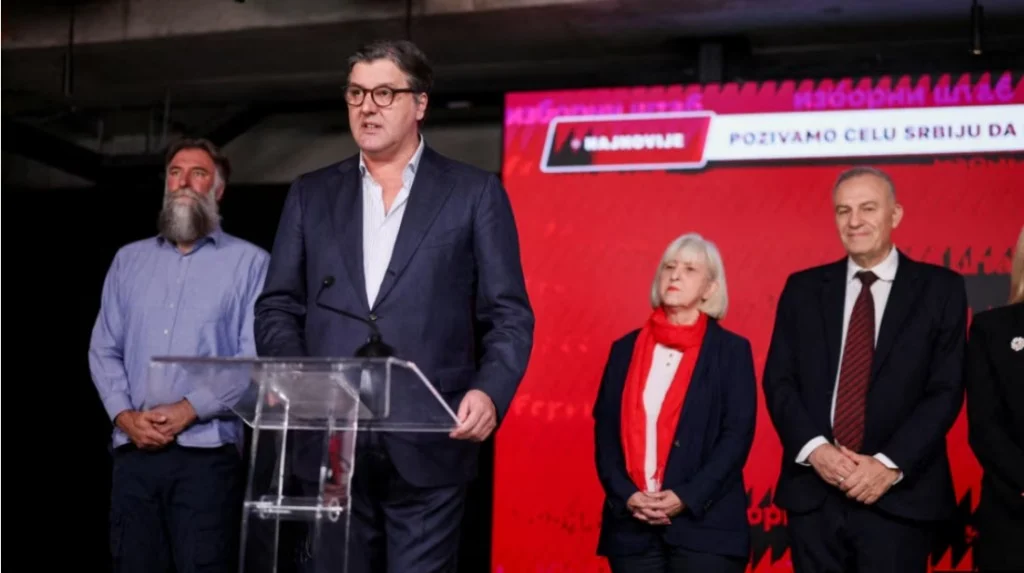
Pristina, October 26 (Albania Journal) – Aleksandar Vučić has conceded defeat in Serbia’s October 25 parliamentary election, saying he expects the Student List to secure a majority in the new parliament.
According to preliminary estimates by CRTA, the Student List is leading with 51.47% of the vote, compared with 40.42% for the “Aleksandar Vučić – United Serbia” list. The figures are not final official results.
The Student List emerged from the student-led anti-corruption protest movement that began after the collapse of the railway station canopy in Novi Sad in 2024, which killed 16 people. The movement does not have a single leader. Students organise through plenums, where decisions are made collectively, and fielded a list of candidates from different professional and social backgrounds for the election.
What Does the Student List Plan for Kosovo?
During the election campaign, Student List candidates called for a review of all agreements reached through the dialogue on normalising relations with Kosovo, the return of Kosovo’s status to the United Nations agenda and decisions on the issue only after consultations with Kosovo Serbs.
It remains to be seen whether the movement will maintain these positions after the election.
Public statements made in Serbia before Sunday’s vote, analysed by Radio Free Europe/Radio Liberty (RFE/RL), indicate that the movement shares the position that “Kosovo is an integral part of Serbia, as stated in the country’s Constitution”.
Student List representatives symbolically carried copies of the Serbian Constitution during the campaign, signalling their intention to defend it and act strictly in accordance with its provisions.
Belgrade does not recognise Kosovo as an independent state. However, negotiations aimed at normalising relations have been taking place under European Union mediation since 2011. Dozens of agreements have been reached during the process, which many political analysts say amount to de facto recognition of Kosovo’s independence.
One of the most significant agreements accepted at the political level by Kosovo Prime Minister Albin Kurti and Serbian President Aleksandar Vučić is the Agreement on the Path to Normalisation of Relations between Kosovo and Serbia, also known as the Basic Agreement. It was agreed in Brussels on February 27, 2023, following a Franco-German proposal.
The agreement provides for respect for territorial integrity and commits Serbia not to oppose Kosovo’s membership in any international organisation. An implementation annex, known as the Ohrid Annex, was agreed on March 18, 2023.
Kosovo, in turn, accepted an obligation to provide Kosovo Serbs with a certain level of self-management through the establishment of an Association of Serb-majority municipalities.
What Happens Next?
Kosovo Prime Minister Albin Kurti has made the continuation of high-level political dialogue conditional on Serbia extraditing Milan Radoičić, who claimed responsibility for the armed attack in Banjska.
The Student List, which could shape Serbia’s state policy over the next four years, has not yet expressed a clear position on the issue.
Criticism over the Banjska attack has largely focused on the Serbian List, the main political party representing Kosovo Serbs. The party was established with the support of the Serbian Progressive Party and Vučić. Until the Banjska attack, Radoičić served as its deputy leader.
Vučić’s departure from power and a possible Student List-led government could change the way Belgrade exercises political influence over Kosovo Serbs, particularly through the Serbian List.
However, Serbia’s influence extends beyond the party. For thousands of Kosovo Serbs, institutions funded by Belgrade provide employment, salaries, pensions and social assistance. Education and healthcare services continue to operate with Serbian funding and employ thousands of members of the Serb community.
The Student List also included four representatives of the University of North Mitrovica, which operates within Serbia’s education system. Among them was Jugoslav Gashić, an assistant professor at the Faculty of Medicine.
Speaking to the Belgrade-based newspaper Danas, Gashić discussed the possible integration of educational and healthcare institutions operating under Serbia’s system in Serb-populated areas of Kosovo.
“If [integration] means only registration in the so-called Kosovo system, it is acceptable to me, but integration as Kosovoisation is absolutely unacceptable,” he said.
Kosovo raised the issue in September last year, arguing that the dual system was unsustainable. The international community, meanwhile, has insisted that any potential integration must take place in consultation with the Serb community.
International representatives have also previously criticised Kosovo authorities for closing Serbian institutions without ensuring alternative arrangements for delivering services to citizens.
Marko Savković believes that the political infrastructure built during Vučić’s time in power would be challenged if he were removed from office.
“That infrastructure would face crises that it would find very difficult to overcome: funding crises, leadership crises and identity crises,” Savković, an associate of the Belgrade Centre for International and Security Affairs, told RFE/RL’s Expose programme in early October.
Such a scenario would not necessarily mean an end to Serbia’s support for Kosovo Serbs. Instead, it raises questions about the form that support would take and the extent to which it would remain tied to political control from Belgrade.
Sonja Biserko of the Helsinki Committee for Human Rights believes a change of government could create room for a different approach.
“For Kosovo Serbs, it would be important for a new government in Serbia to have a realistic approach towards them, to help them strengthen their position in Kosovo and guide them towards dialogue with Pristina. That would be the best solution for them,” Biserko told RFE/RL’s Expose programme.
During a debate on Serbia’s public broadcaster, Gashić said that if the Student List came to power, it would insist that all agreements signed with Kosovo undergo parliamentary procedures and review by the Constitutional Court, with the possibility of revising them.
It remains unclear whether this would mean legal challenges to previously accepted obligations, a political reassessment of the agreements or changes to the way Belgrade implements them.
Political scientists Ognjen Gogić and Aleksandar Šljuka, who follow relations between Kosovo and Serbia, have previously told RFE/RL that any future Serbian authorities would be unable to withdraw from the dialogue without risking relations with the European Union.
The Kosovo Memorandum
Earlier this year, the Student List published a Kosovo Memorandum at one of its rallies, describing Kosovo as an “inalienable and integral part of the Republic of Serbia”.
The document drew criticism from some sections of Serbian public opinion, with critics arguing that nationalist policies alone would not be enough to defeat the Serbian Progressive Party. The memorandum contains four points.
One states that the Kosovo issue “cannot be resolved in isolation, but only within the complex developments of the international community”. It also says Serbian authorities should “actively and constructively cooperate with all relevant international organisations” to find a lasting solution “within the framework of their Constitution”.
At the end of September, the students released another instalment of their election campaign titled “Kosovo Betrayal”.
Their criticism of Vučić is not based on the argument that Serbia should recognise Kosovo. Instead, they point to developments that have taken place under his government, including the removal of Serbian licence plates and the Serbian dinar from Kosovo, as well as the closure by Kosovo authorities of institutions operating under Serbia’s system.
However, the position that Kosovo is part of Serbia has been shared by most Serbian governments since the fall of Slobodan Milošević’s regime and remains widely held among Serbian citizens.
According to a 2023 survey by the Institute for European Affairs, more than 50% of Serbian citizens opposed Kosovo’s independence.
Savković said opposition to Kosovo’s statehood did not begin with Vučić and was unlikely to end with him.
Speaking to RFE/RL, he said political space in Serbia for a fundamentally different approach to Kosovo’s status remained very limited.
“When it comes to opposing Kosovo’s statehood itself as a concept, this is certainly state policy, and a certain continuity can be expected here, whoever is in power in Serbia. Political options that accept the de facto situation, because Kosovo is de facto a state, are few and are on the political margins,” Savković told RFE/RL’s Expose programme.
Biserko also does not expect a rapid change in Serbia’s approach to Kosovo’s status, even if a new government takes power in Belgrade.
“It is certain that, in different crisis situations, everyone will try to use Kosovo for emotional mobilisation, to rally people around themselves. I think that, fundamentally, there will be no changes regarding Kosovo’s status. That is ruled out,” Biserko told Expose.
