

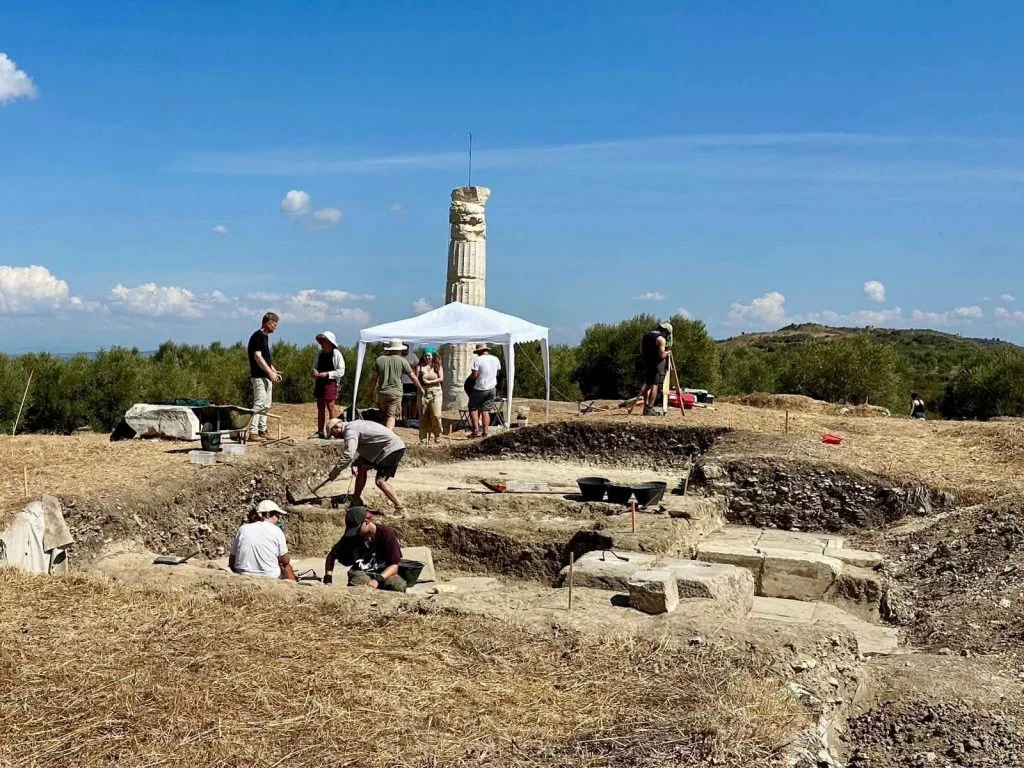
Tirana, October 31 (Albania Journal) – Archaeological excavations at the ancient Temple of Shtyllas, a Category I cultural heritage monument located near the Apollonia Archaeological Park, are uncovering new evidence about the site’s history and architectural significance.
Albania’s Minister of Tourism, Culture and Sport, Blendi Gonxhja, announced that an Albanian-German-Romanian archaeological mission is continuing its research at the site in collaboration with the Institute of Archaeology in Tirana and the Winckelmann Institute at Humboldt University of Berlin.
According to Gonxhja, the excavations have helped establish the temple’s complete ground plan. The discovery of reused stone blocks in its foundation also provides evidence of an earlier structure dating to before the 4th century BC.
Architectural fragments and marble roof tiles recovered during the excavations further highlight the importance and distinctive features of the Doric-style monument. The temple stood overlooking the river port of the ancient city of Apollonia.
The discoveries are expected to expand understanding of Apollonia’s urban development, architecture and history. The ancient city was one of the most important centres of civilisation in what is now Albania.
Gonxhja said the research findings would contribute to more comprehensive documentation of the archaeological heritage and help communicate the site’s historical significance to both domestic and international visitors.
Archaeological investigations conducted in previous years have also provided evidence of the approximately 2,500-year-old temple, whose foundation remains largely intact. Initial estimates suggest that the structure covered an area of around 1,000 square metres.
The temple is believed to have served religious purposes for the ancient city of Apollonia and was considered one of the region’s most important sanctuaries. Its proximity to the city’s river port further underlines its historical significance.
The village of Shtyllas in the Fier region is believed to have derived its name from a column associated with the ancient temple. The ongoing research aims to shed further light on the monument’s architectural features and its role in the religious and urban life of ancient Apollonia.
